Caldwell-Luc Operation / Intra-OralAntrostomy
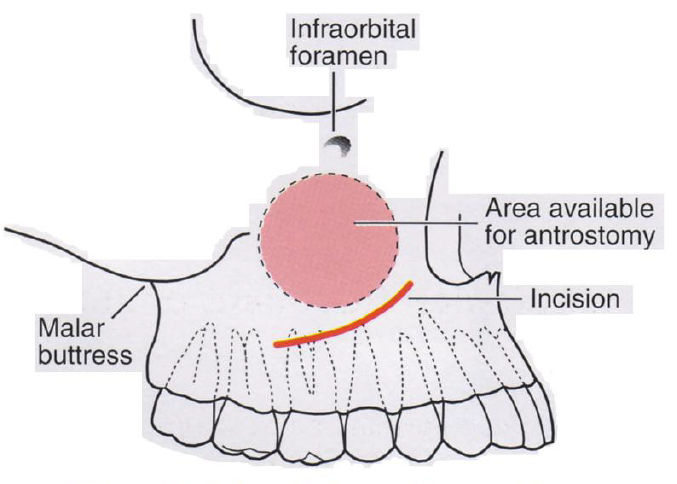
The Caldwell-Luc operation (in the Oral Surgical use of the procedure) is used for the:
- Removal of tooth roots from within the (maxillary) sinus
- Removal of dental cysts within the (maxillary) sinus
- Closure of mouth-sinus communications (oro-antral fistulæ)
- Reduction of facial fractures especially those involving the orbital floor
In the Ear, Nose & Throat sense, the Caldwell-Luc procedure is used for:
- Treatment of chronic sinusitis
- Removal of antral polyps and cysts & antro-choanal polyps
- Removal of antral mucocœles
- A route to the ethmoid and sphenoid sinuses
- Visualisation of the orbital floor for decompression
- Vidian (nerve of the Pterygoid Canal) neurectomy
- Various forms of tumour surgery and
- Access to the pterygo-maxillary fossa (the space behind the maxillary sinus).
Having said this though, this procedure is dying a death as Functional Endoscopic Sinus Surgery (FESS) is superceding the Caldwell-Luc procedure. It is associated with far less problems (as listed below). As I have experienced, when patients are given the option of either a FESS or a Caldwell-Luc, most patients opt for a FESS (understandibly).
The procedure can be carried out under Local Anaesthetic though it may be a pleasanter experience all round for it to be carried out under General Anaesthetic. A small cut is made between the upper lip and gum and a bony window is made (giving access to the maxillary sinus) in the anterior wall of the maxillary sinus. The natural opening of the sinus into the nasal cavity is often enlarged at the same time to improve drainage of normal secretions and reduce the chance of recurrent disease. Occasionally, a new opening (naso-antral window) is also created between the nose and maxillary sinus.
This list of warnings might seem excessive to some however the legal ruling in the case of Chester vs Afshar (2004) would suggest that it is quite prudent / necessary to list them. Others might say that there isn’t enough information but where do you stop?
The following list of warnings regarding the Caldwell-Luc operation is neither exhaustive nor is it predictive.
These are the commoner risks. There may be other unusual risks that have not been listed here. Please ask your Oral Surgeon if you have any general or specific concerns.
 The Caldwell-Luc surgical procedure showing the site of the window into the anterior maxillary sinus.
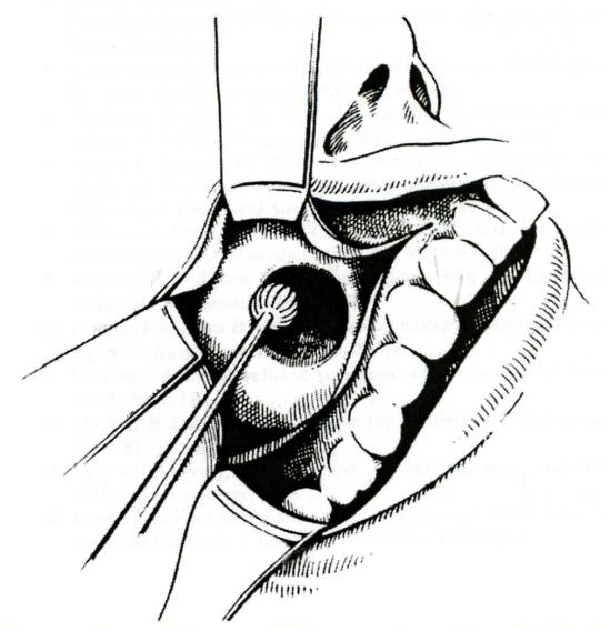 Diagram showing the surgical technique where a long sub-labial incision facilitates gentle tissue retraction and the anterior antrostomy is created by a cutting burr.
Common Complications:
- Pain
- Sutures
- Trismus
- Infection
- Adjacent teeth damaged whilst making hole into the Sinus
- Bruising / Black Eye
- Facial swelling
- Pain ± numbness of the face (infra-orbital neurapraxia). This is numbness of the cheek and not weakness, which always occurs temporarily but rarely persists.
- Pain ± numbness (temporary / permanent) of the upper teeth (incisors around to the bicuspids) and the associated gums.
Less Common Complications:
- Failure of the cut to the gum above the upper teeth to heal, which can result in a mouth-sinus communication (oro-antral communication / fistula) (< 1%). This may close spontaneously with time or may require further surgery.
- Post-operative nosebleeds (epistaxis)
- Overflow of tears (epiphora) due to blockage of the tear duct.
- Tooth root injury leading to tooth death (devitalisation) & tooth discoloration.
Rare Common Complications:
- Facial asymmetry due to persistent facial swelling attributed to scarring and thickening of the facial tissues (possibly due to escaped lymphatic fluid from the damaged lymphatic channels following excessive retraction of the cheek).
- Prolonged maxillary sinusitis.
- Post-op bleeding from the sinus / nose requiring packing of the sinus / nose or even a blood transfusion.
- Infection of the naso-lacrimal sac (dacryocystitis) (2ndary to naso-lacrimal duct obstruction).
- Post-op hypersensitivity or ‘burning’ pain over the cheek, gums or teeth (hypæsthesia / dysæsthesia of the Infra-Orbital Nerve).
- Blindness (if the eye socket is entered) & reduced sharpness of vision & movement of the eye (ocular dysfunction).
Useful Articles & Websites
Clinical Dentistry & Research 2011. Ectopic Molar Tooth in the Maxillary Sinus. A Case Report
Indian J Otolaryngol Head Neck Surg 2016. Caldwell Luc Surgery – Revisited
OHDM 2017. Dental Bur into the Maxillary Sinus – A Case Report