Desquamative Gingivitis
The term ‘desquamative gingivitis’ is a clinical description, not a diagnosis.
It is used for conditions in which the gingivæ (gums) appear red or raw. Usually the whole of the attached gingiva of varying numbers of teeth is affected.
This is a clinical descriptive term used for non-specific gingival (gum) manifestation of several chronic muco-
With rare exceptions, an auto-immune mechanism is responsible. Cicatricial Pemphigoid and Lichen Planus are the most common auto-immune diseases that manifest Desquamative Gingivitis.
Less commonly are Bullous Pemphigoid, Pemphigus, Linear IgA Disease, Epidermolysis Bullosa Acquisita (weblink), Chronic Ulcerative Stomatitis, Discoid Lupus Erythematosus and Psoriasis.
Desquamative Gingivitis has also been associated with:
- Chemical damage, such as reactions to sodium lauryl sulphate in toothpastes.
- Allergic responses.
- Drugs.
- Pyostomatitis vegetans.


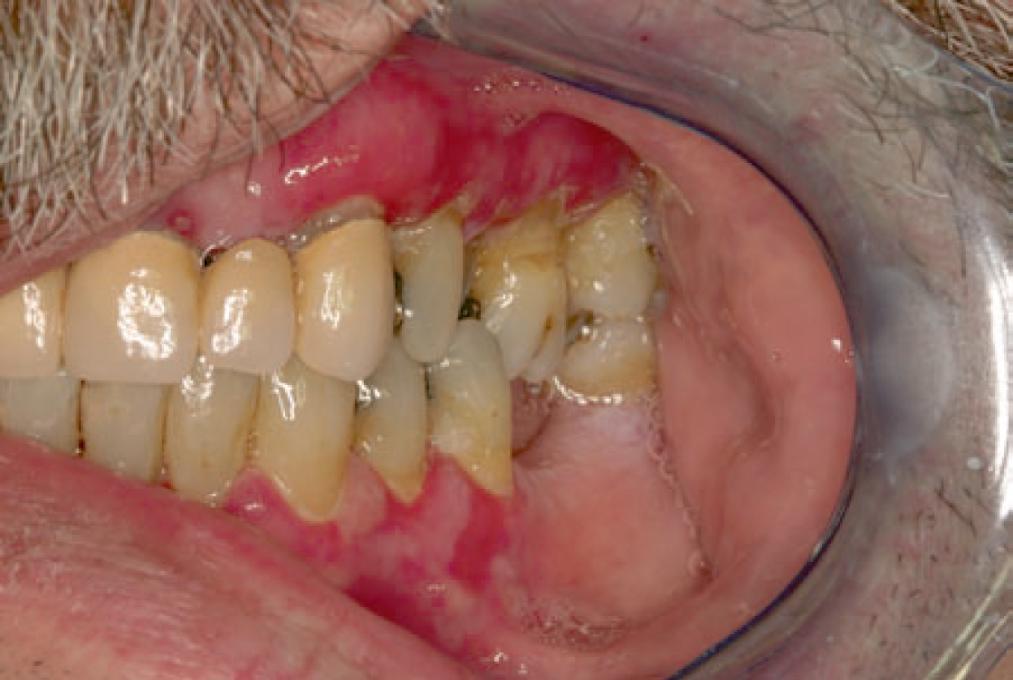
attached gingiva (gum).
The ‘facial’ (that is, the surfaces facing out towards the lips and cheeks) surface is more frequently affected than the lingual / palatal gingivæ. Spontaneous desquamation of the epithelia, blister formation and areas of superficial erosions are common.
Some patients make no complaint, but the main complaint is of persistent soreness of the gingivæ; worse when eating acerbic or spicy foods such as tomatoes, citrus fruits and others.
The desquamation may vary from mild, almost insignificant small patches to widespread redness a ‘glazed’ appearance.
In addition to a full history and examination, biopsy examination and appropriate histo-pathological and immunological investigations are frequently indicated.
Some other conditions can present with redness or ulcers rather than the atrophy or erosions typical of Desquamative Gingivitis and should be excluded.
Such appearances may be seen in:
- reactions to various mouthwashes, chewing gum, medications and
- dental materials
- candidiasis (Thrush)
- lupus erythematosus
- plasma cell gingivitis
- Crohn’s disease, sarcoidosis and oro-facial granulomatosis
- leukæmias
- factitial (self-induced) lesions.
The treatment of desquamative gingivitis consists of:
- improving the oral hygiene
- minimising irritation of the lesions
- specific therapies for the underlying disease where available
- often local / systemic immuno-suppressive or dapsone therapy, notably cortico-steroids. Cortico-steroid creams used overnight in a soft polythene splint, may help.